🏋️ Practice Workbook — BRAND-NEW problems
Same 4 topics as the exam · different numbers she's never seen
Do them on paper (or in the boxes), then open the answer key to check.
Rule: don't peek at the answers until you've fully tried each one. That's how training works.- Print it, or write in the grey boxes / on paper.
- Show every step — the real exam gives marks for working, not just the answer.
- Finish a whole topic, then open its ✅ Answer key and mark yourself.
- Anything you got wrong → redo it tomorrow from scratch.
1 Solve these quadratic equations
Move everything to one side first. Then pick: common factor, square root, or the formula. Watch for "no real solution".
✅ Answer key — Topic 1
| # | Answer | How |
|---|---|---|
| a | x = 0, x = 5 | factor x(x−5) |
| b | x = 0, x = −4 | factor 3x(x+4) |
| c | x = 2, x = 5 | (x−2)(x−5) |
| d | x = −5, x = 3 | (x+5)(x−3) |
| e | x = 5, x = −1 | √: x−2 = ±3 |
| f | x = 1, x = −3 | (x+1)²=4 → ±2 |
| g | x = −4 ± √5 ≈ −1.76, −6.24 | √ method |
| h | x = −2 ± √3 ≈ −0.27, −3.73 | formula, Δ=12 |
| i | x = 2, x = −0.5 | formula Δ=25, or (2x+1)(x−2) |
| j | x = 3 (only one) | (x−3)², Δ=0 |
| k | No real solution | Δ = 4−20 = −16 < 0 |
| l | x = 0.5, x = −3 | already factored |
2 Analyze each function fully
For each one find: domain · opens up/down · zeros · vertex · y-intercept · image · positivity/negativity, and draw the graph.
✅ Answer key — Topic 2
| f(x) | Opens | Zeros | Vertex | Y-int | Image | Positive / Negative |
|---|---|---|---|---|---|---|
| a) (x−1)(x+5) | up | 1, −5 | (−2, −9) | −5 | y ≥ −9 | + : x<−5 or x>1 − : −5<x<1 |
| b) x²−4x−5 | up | 5, −1 | (2, −9) | −5 | y ≥ −9 | + : x<−1 or x>5 − : −1<x<5 |
| c) −(x−2)²+9 | down | 5, −1 | (2, 9) | 5 | y ≤ 9 | + : −1<x<5 − : x<−1 or x>5 |
| d) x²−16 | up | 4, −4 | (0, −16) | −16 | y ≥ −16 | + : x<−4 or x>4 − : −4<x<4 |
| e) 2(x+1)²−8 | up | 1, −3 | (−1, −8) | −6 | y ≥ −8 | + : x<−3 or x>1 − : −3<x<1 |
| f) 3x(x−2) | up | 0, 2 | (1, −3) | 0 | y ≥ −3 | + : x<0 or x>2 − : 0<x<2 |
Dominio de todas: ℝ. Para graficar: marcá raíces + vértice + ordenada al origen y uní con curva suave.
📈 The 6 graphs — compare with your drawings
a) (x−1)(x+5)
b) x²−4x−5
c) −(x−2)²+9
d) x²−16
e) 2(x+1)²−8
f) 3x(x−2)
3 Word / graph problems
Spot the pattern: factored form → intercepts & vertex · vertex form → find d · complete the square / discriminant = 0.
✅ Answer key — Topic 3
| # | Answer | Key step |
|---|---|---|
| 1 | A(−1, 0), B(2, 9), C(5, 0) | zeros 5 & −1; vertex x = midpoint = 2, y = 3·3 = 9 |
| 2 | (a) p = −3, q = 1 (b) x = −1 | p,q are the intercepts; min x = midpoint of −3 & 1 |
| 3 | (a) m = 5, p = 4 (b) d = −4/9 ≈ −0.44 | m = midpoint of 2 & 8; put (2,0): 0 = 9d + 4 |
| 4 | (x − 3)² + 2; minimum value = 2 | x²−6x = (x−3)²−9, then −9+11=2 |
| 5 | (a) vertex (2, −5) (b) a = 2 | f(0)=3: a(4)−5=3 → 4a=8 |
| 6 | k = 9 | Δ = 36 − 4k = 0 |
| 7 | k = 2 | Δ = 36k² − 144 = 0 → k² = 4, k > 0 |
4 Systems with 3 unknowns
Tidy brackets first → eliminate one variable → solve the 2×2 → back-substitute → check. Show all working.
x − y + z = 2
2x + y − z = 1
x − y + 2z = 5
3x + 2y + z = 10
2(x − y) = z + 2
3x − y + z = 10
✅ Answer key — Topic 4
| System | Solution (x, y, z) | Quick check |
|---|---|---|
| A | x = 1, y = 2, z = 3 | 1+2+3 = 6 ✓ |
| B | x = 2, y = 1, z = 2 | 3(2)+2(1)+2 = 10 ✓ |
| C | x = 3, y = 1, z = 2 | 2(3−1)=4 = 2+2 ✓ |
Tip: en C, ordená la 2ª como 2x − 2y − z = 2 antes de empezar.
📝 Full mock exam (do it timed, like Monday)
✅ Answer key — Full mock
| Q | Answer |
|---|---|
| 1a | (x+5)(x−2) → x = −5, x = 2 |
| 1b | (x−2)² = 4 → x = 4, x = 0 |
| 1c | Δ = 49 → x = 1.5, x = −2 [(2x−3)(x+2)] |
| 2 | Domain ℝ · opens up · zeros 4 & −2 · vertex (1, −9) · y-int −8 · image y ≥ −9 · + : x<−2 or x>4, − : −2<x<4 |
| 3 | vertex (3, −2); f(1)=6 → 4a−2=6 → a = 2; y-int f(0)=2(9)−2 = 16 |
| 4 | x = 1, y = −1, z = 4 (check: 1−1+4=4 ✓) |
🎉 Si llegaste hasta acá, Faustina…
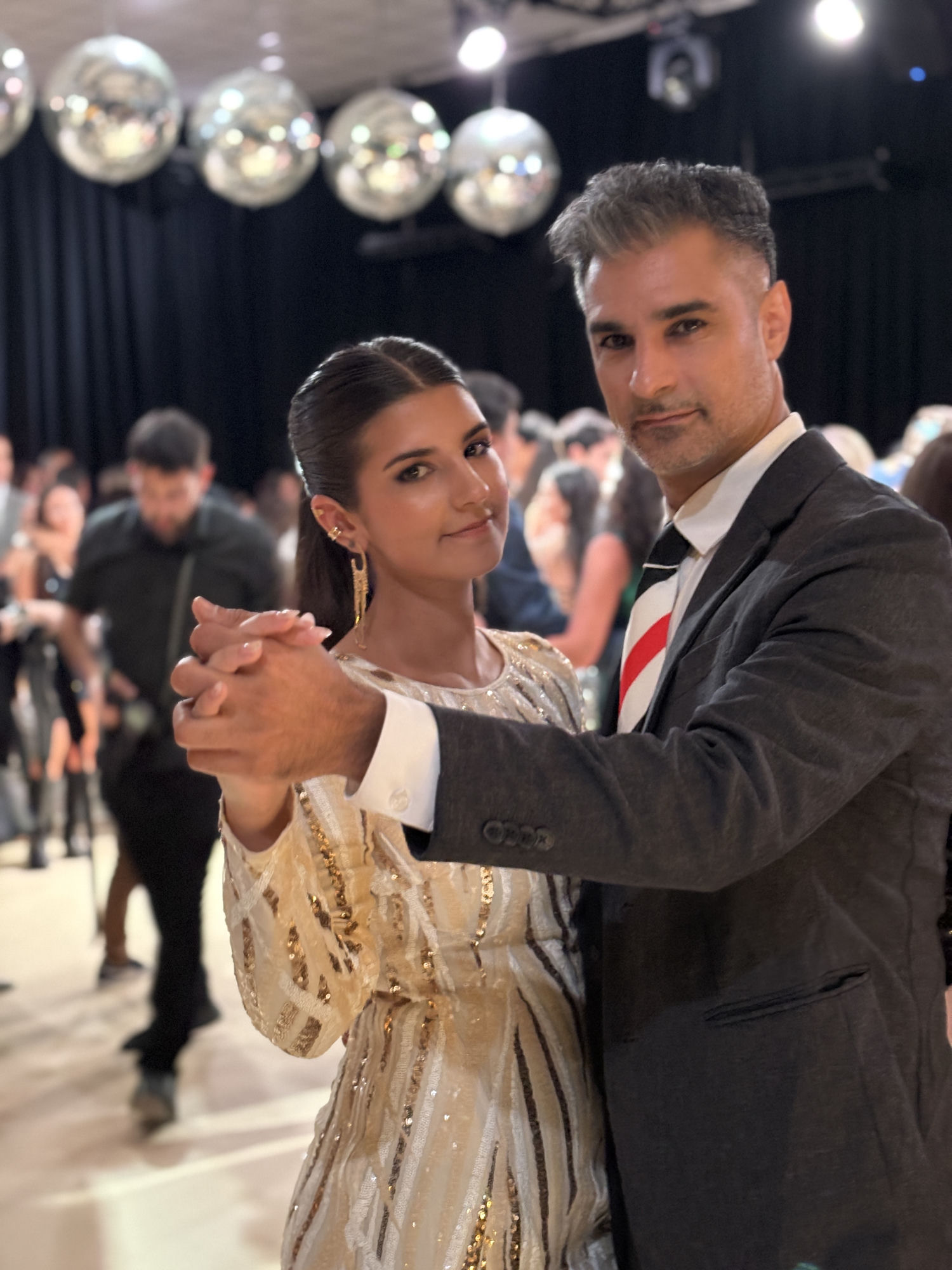
Ya hiciste lo más difícil: practicar. Estoy infinitamente orgulloso de vos. Pase lo que pase el lunes, para mí ya ganaste — igual que ganamos esa noche bailando en tus 15. Te amo muchísimo. — Papá ❤️🤍❤️